What do Palestine, Colombia and Brazil have in Common?
Arabic Translation can be found here.
Written by Bruna Montuori - Translated by Hala Sabbah.
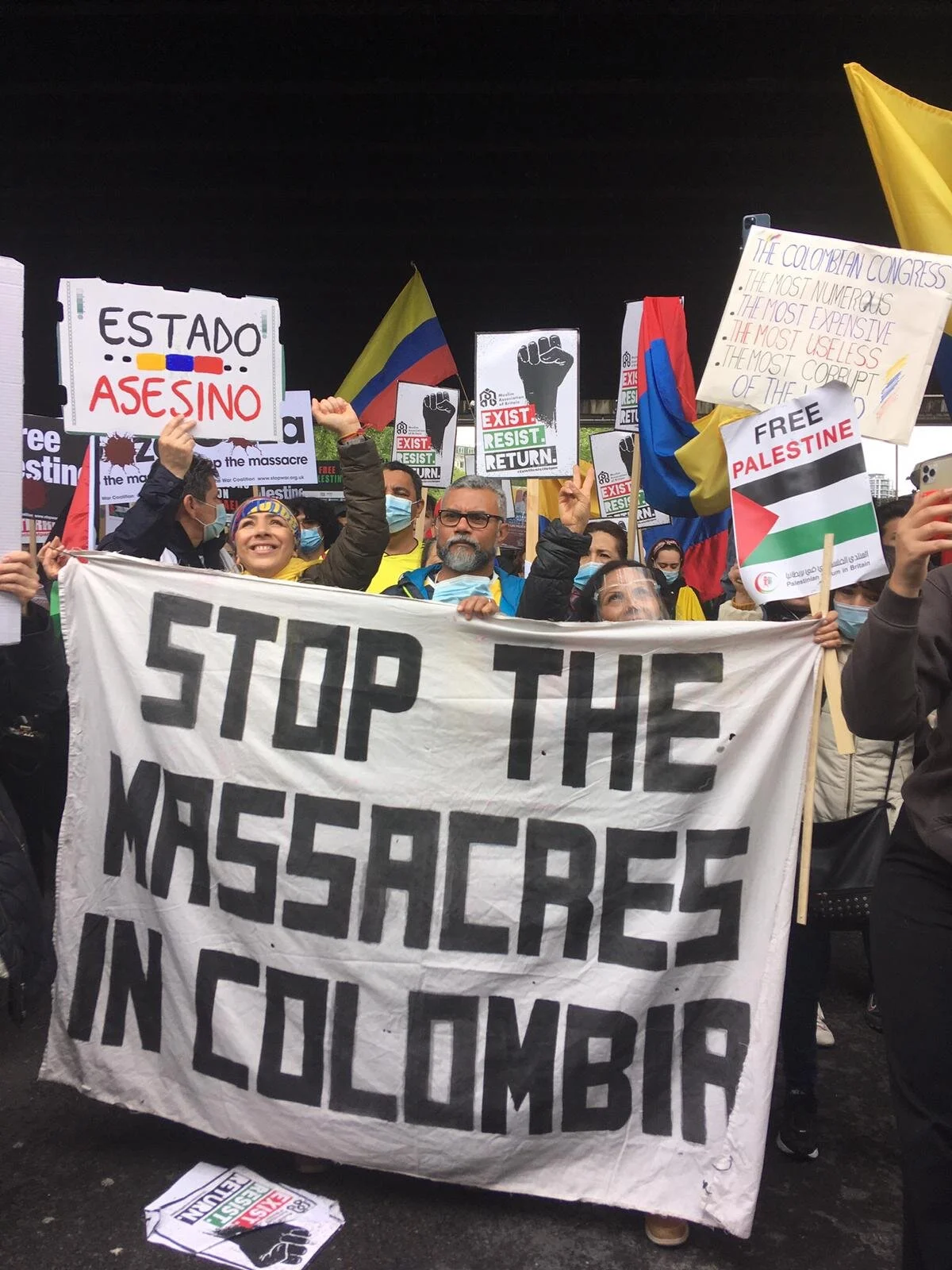
Amidst social, economic and health crisis, the deadly coronavirus, and uneven distribution of vaccines, territories outside of the boundaries of the Western social order deal with despair. Palestinians are at the epicenter of a massive settler-colonial project, massacred by Israeli bombs that are destroying homes, offices and the lives of hundreds of civilians in Gaza and through the occupation of Sheik Jarrah neighbourhood in East Jerusalem. Meanwhile on the other side of the ocean, residents of the city of Cali in Colombia resist violent State repression whilst fighting against a tax reform that privileges the wealthy. Not so far away, a slaughter occurred in the favela of Jacarézinho in Rio de Janeiro, Brazil, in which 29 people died during a 9 hour police operation that aimed to “protect children from drug criminals”, as posed by Rio's State governor, although it ended up killing people in front of children.
Despite their distances, many similarities tie these three sites into a common thread: who is authorized to live and who is not. As we observe the rise of right wing fascist rulers in power, unleashing the violent tactics of white supremacists, discourses embedding ethnic cleansing, silencing voices and historical erasure become ever more validated. As much as this legacy draws from long term histories of oppression they are gaining a particular character as the global tech neoliberal economy becomes the norm. Due to the Nakba in 1948, Palestinians have been living in refugee camps for over 70 years, and have been criminalised in their own lands. Meanwhile for Black and brown Brazilian favelados, police brutality has been the rule since the emergence of its first favelas in late 19th century.
In Colombia and parts of Brazil, indigenous communities have been killed, exploited for labour, endangered because of the State’s extreme and harmful measures to extract from nature (e.g. mining, fishing, etc.).The ones who are granted the right to exist are the ones who obey and accept the uniformisation of militarized neoliberal politics. The latter is structured to support the capitalist ideology of excessive wealth accumulation, which is only feasible for a small privileged group living the American overconsumption dream while the planet collapses. According to these politics, life is trivialized and dissolved into mainstream media discourses endorsing hate and racial apartheid. The problem is not religion, drugs or tax reform, it is the instrumentalized death strategies to eliminate the unwanted, the “less than human” voices.
While Gaza residents pray every night to survive Israeli-US funded bombs, the BBC portrays the inexistent conflict –i.e. the occupation– through its prime minister’s speech “We will end the anarchy” as a needed heroic act. The criminalization of race is a key strategy to undermine and dehumanize the lives of people who already struggle to survive within racial capitalism. Across Cali and Rio de Janeiro, the idea of human rights is only addressed for those who are “right humans”, the ones who support traditional values of family, christianity, support neoliberal ideals and typically have a white skin appearance. These problematic views on human rights are seen in speeches by Bolsanaro, the Brazilian president, who makes statements such as “human rights for the right humans” or “human rights: the ultimate stupidity.” In cases like Jacarézinho and other favelas in Rio, residents call for the end of police operations, a strategy ruling since colonial times, that reinforces the stereotypes over favelas’ residents as filthy and criminals. Yet, not to forget, these people are the maids, porters, bus drivers, cleaners, security guards working for white wealthy families and businesses in the Southside of Rio, serving a small elite who is constantly afraid of Blackness.
Living at the intersection of oppressions, residents of these three places remind us of what it is like to be at the spotlight of necropolitics. Achille Mbembe helps us understand what differentiates the military and police treatment of whites from the other, the excluded, the unwanted. Necropolitics envisions social and political power by determining how certain people are allowed to live and how others should die, according to their unequal opportunity to live and die in the current ultraliberal capitalist system.
What our eyes cannot see is visible at the intersection of oppressions: the black and muslim mothers who are afraid to let their children out of the house, who are worried sick for their relatives struggling and overexposed to the virus and military extermination. The children who cannot grow in a healthy environment, without proper education, and a safe space to play. Whether because their schools or public spaces were bombed, there are shootings outside, or because of the lack of basic minimum infrastructure and urban mobility. The elderly who are prone to get the virus and cannot access hospitals and health clinics, who are constantly worried for their younger generations exposing themselves and dying before they can return home. All of them receive what Boaventura de Sousa Santos addressed as a violence and appropriation based governance - where Western countries are entitled to values of emancipation and regulation, in favor of their freedom, they resort to violence and appropriation through fascist State governors, a colonial strategy from the 16th century, still applied today towards those who “deserve” domination.
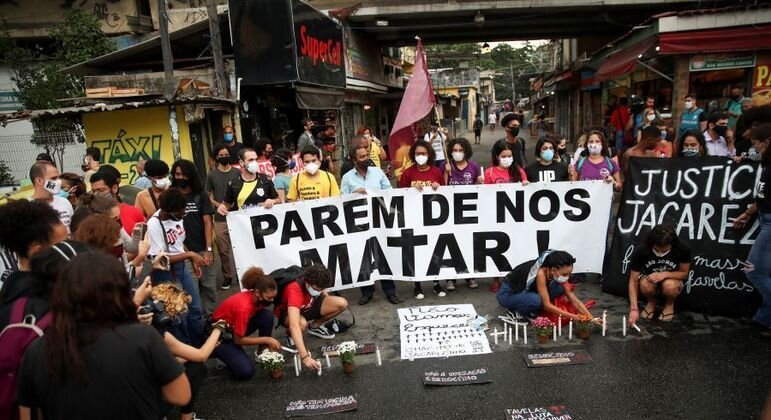
Source: Reuters
The use of militarized violence as a strategy to silence voices evolves with the high influxes of funding from wealthy Western countries, such as the United States and European countries. Hiding under the discourse of technological development and advancement, whiteness moves forward with its political project, homogenizing every place it touches with its whitening wand. When the right to narrate is narrowed to such an extent, you notice the world is looking more like a shopping mall. As members of different black movements of Rio usually say: “the cheapest meat in the market is the black one”. Not only the Black one, the Muslim, the diasporic, the immigrant, the refugee, the favelado, the poor, the queer, the disabled. The gentrification of the world is not an instagrammable revitalization project, with cocktails and artificial beaches; it is instrumentalized with innocent blood of people who resist, wishing for the bare minimum: liberation, a normal life in peace and freedom to exist. While these unwanted voices are erased, they resist for another generation, and another, working through the cracks of the hegemonic established order. When racial technology reaches its peak, and all forms of life are dominated, extinct and destroyed, new uniformised generations will remember those who resisted for centuries, and think: we had our chance, but we missed it.
About Bruna
Bruna Montuori is an urban researcher and designer working between London and Rio de Janeiro. She is a PhD Candidate at the School of Architecture, Royal College of Art. Her research investigates narratives and spatial justice through the work of Redes da Maré organisation in Maré, Rio de Janeiro. She is a Postgraduate Rep of the Participatory Geographies Research Group (PYGYRG) and co-founder of the Relational Design research group at the University of São Paulo. She is the current president of ABEP-UK, an association supporting Brazilian postgraduate researchers in the UK.
Sources: https://exame.com/brasil/general-heleno-defende-direitos-humanos-para-humanos-direitos/