
Why Are Tears Salty? What Tear Salt Does for Your Eyes
The salty taste of tears comes from dissolved electrolytes, mainly sodium and chloride. In their normal balance, these salts are part of a protective fluid that keeps your eyes comfortable. A grain of salt stings because its physical form and local concentration differ from those of your tears.
Why Are Tears Salty?

The salty taste comes mainly from sodium and chloride, both electrically charged particles known as ions; they are dissolved throughout the watery part of your tears, alongside other electrolytes such as potassium. When a tear runs down your cheek and reaches the corner of your mouth, you taste them.
Where Does the Salt in Tears Come From?
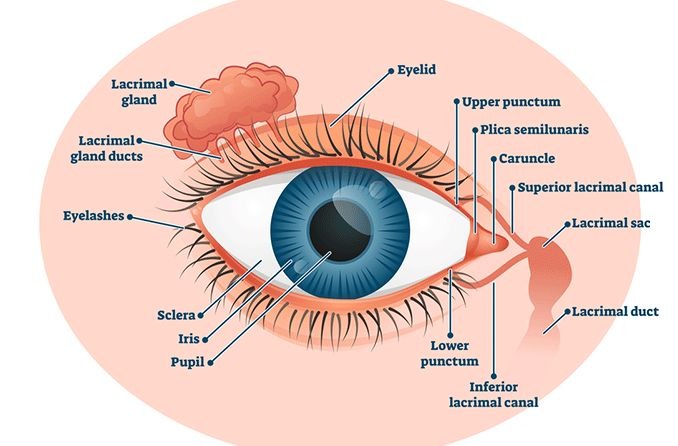
The lacrimal glands produce much of the watery part of tears. They move ions into their fluid, and water follows by osmosis. That is how electrolytes end up in your tears.
Tears flow from the glands onto the eye, and each blink spreads the tear film across the cornea, the clear front surface of the eye. Excess fluid collects at small openings near the inner corners of the eyelids called lacrimal puncta, then drains toward the nose.
The National Eye Institute's August 2025 guide, How Tears Work, illustrates the production and drainage route.
What Else Is in Tears, and What Does It Do?
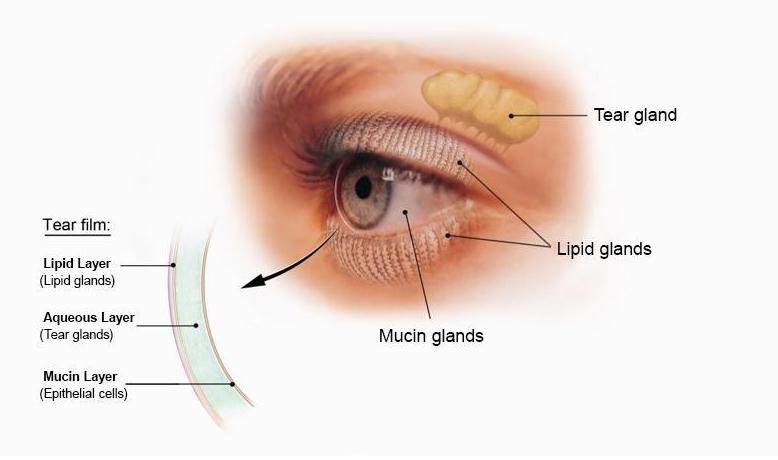
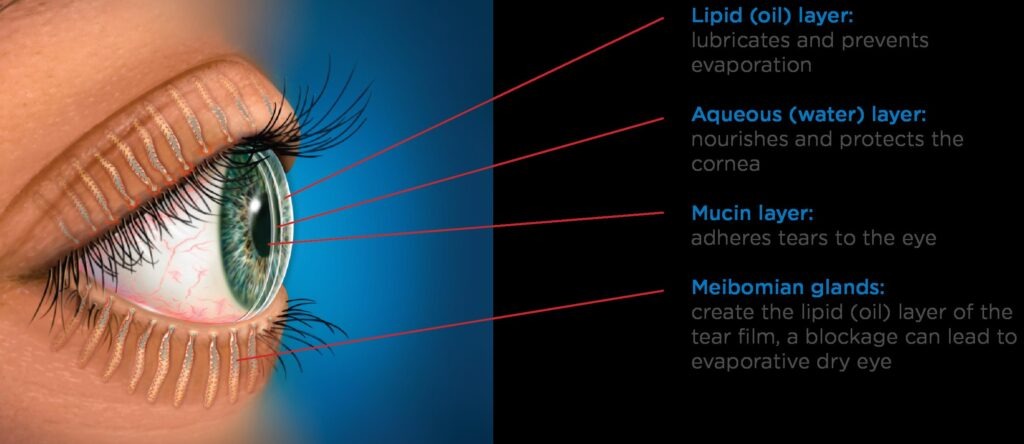
Water carries the dissolved salts along with other materials that protect the surface of your eye. Each blink spreads a thin coating that keeps the eye moist and shields it from irritation.
The classic description divides this film into three layers: oily on the outside, watery in the middle and mucus-related on the inside.
| Component | What it contributes |
|---|---|
| Water and electrolytes | Moisture and a suitable fluid environment for the eye's surface |
| Mucins | Help the tear film spread and stay attached to the eye's surface |
| Lipids (oils) | Limit evaporation and stabilize the film |
| Proteins and enzymes | Support protection, including defense against some microbes |
The oily material comes largely from meibomian glands in the eyelids. Mucins come from cells on the surface of the eye. Because the sources differ, no single gland produces the whole mixture.
An evenly spread tear film gives light a smooth surface to enter through, and the fluid carries away small particles and irritants. Eyelid reflexes and sneezing are separate from tear function; the sneeze-and-eyelid explainer focuses on the reflex.
The 2018 Contact-Lens Biosensors review reports measured tear-fluid sodium concentrations of 120 to 165 mM and chloride concentrations of 118 to 135 mM. Here, mM means millimoles per liter. The figures are published ranges from different samples and methods.
If Tears Contain Salt, Why Don't They Normally Sting?
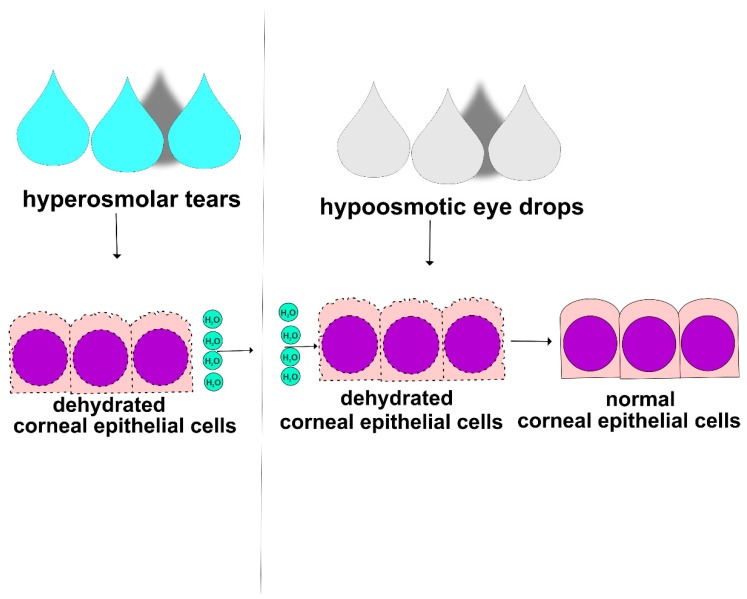
Normal tears contain dissolved salts at concentrations the surface of your eye tolerates. A grain of salt differs in two ways. A dissolved substance spreads evenly through liquid, while a salt crystal is a solid that irritates the eye on contact. As the crystal dissolves, it briefly creates a concentrated patch of fluid around it.
Concentration also affects how water behaves around living cells. Osmolarity is the total concentration of dissolved particles that contribute to osmotic effects in a solution. When the balance around the surface of the eye changes, water movement and irritation change with it.
The same question drew a concise response in r/NoStupidQuestions:
The liquid in your eye is a saline solution (my very scientific reasoning is that tears are salty :P ). Howcome when I get a little bit of salt in my eye it stings, but when water drops hit my eye it doesnt?
Should't the salt have no feeling other than the regular "something just hit my eye" like water does?
Update :
It has been answered: Too much salt bad.
Thanks guys !
Physical contact, other substances in a liquid and the condition of the eye's surface also affect whether something stings. Your normal tears can feel uncomfortable when the surface of the eye is already irritated.
Do not test these differences by putting salt or experimental liquids into an eye.
Are Emotional Tears Saltier Than Other Tears?
No fixed ranking of sodium or chloride concentrations across tear types has been established. Scientists distinguish three broad kinds of tears by what prompts them and what they do, and the same tear-producing system is involved in all three.
| Tear type | Typical trigger or setting | Main role |
|---|---|---|
| Basal tears | Normal blinking throughout the day | Maintain routine moisture and protection |
| Reflex tears | An irritant, such as onion fumes or airborne debris | Help flush and protect the eye |
| Emotional tears | Strong feelings, including sadness or joy | Accompany emotional crying |
A 2026 study of emotional and reflex tear metabolites compared tears from 22 healthy volunteers. Metabolites are small molecules involved in biological processes. The first analysis showed some differences, but none stayed statistically significant after adjustment for multiple comparisons. The study also lacked independent validation.
Check what a claim about emotional tears actually measured. Metabolites, sodium concentration and someone's impression of taste answer different scientific questions.
What Can Tear Saltiness Tell You?
Very little on its own. A tear drying on your skin can leave a faint residue, but that trace does not measure how much sodium you lost through crying. A stronger or weaker salty taste is a sensory impression, and it cannot determine tear composition without controlled sampling.
Eye-care professionals assess tear-film problems using clinical context and appropriate measurements. The TFOS DEWS II Diagnostic Methodology Report discusses tear osmolarity alongside other clinical findings.
Persistent burning, pain, or unusual watering calls for an evaluation by an eye-care professional, because taste cannot identify the cause.