
How Much Does Hair Weigh? What Changes the Number
A head of hair has no single standard weight; its mass depends on the number, length, and thickness of the strands. For example, 100,000 hairs averaging 15 cm long and 70 μm thick, at a fiber density of 1.312 g/cm³, weigh about 76 g (2.7 oz). Wet hair and extensions add weight, while a dry cut sample can be weighed directly.
How Much Does a Full Head of Hair Weigh?
In this guide, hair weight refers only to the shafts growing from your scalp—not the scalp tissue, follicles, or accessories. The worked example uses one combination of hair count, length, and diameter; changing those inputs changes the answer. The table below gives 20.6 g for shorter, finer hair and 300.5 g for a longer, coarser combination.
Why Length, Strand Count, and Thickness Change the Weight
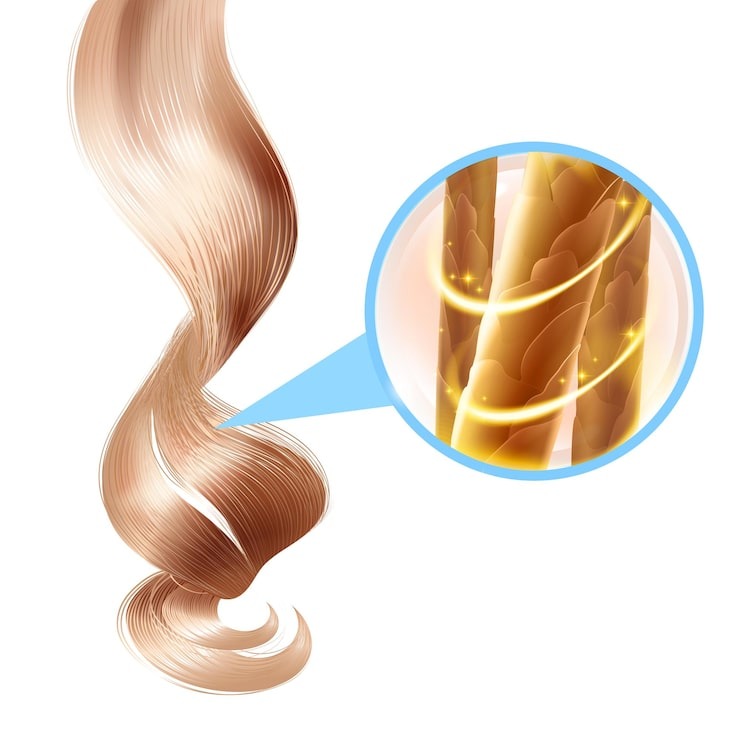
Model a hair as a very narrow cylinder. The mass of one strand depends on its length, cross-sectional area, and fiber density. Multiply by the number of strands and you have the mass of a whole head. The human scalp-hair number explainer examines strand length, follicle density, and hair count.
The result depends on four quantities:
- Strand count (N): how many shafts you include.
- Average fiber length (L): the mean length measured along the shafts.
- Strand diameter (d): the width of a shaft. Its cross-sectional area depends on diameter squared.
- Fiber material density (ρ): the mass of a given volume of hair fiber.
The basic model is M = N × L × π × (d / 2)2 × ρ, with length and diameter in centimeters and density in grams per cubic centimeter. The result is in grams.
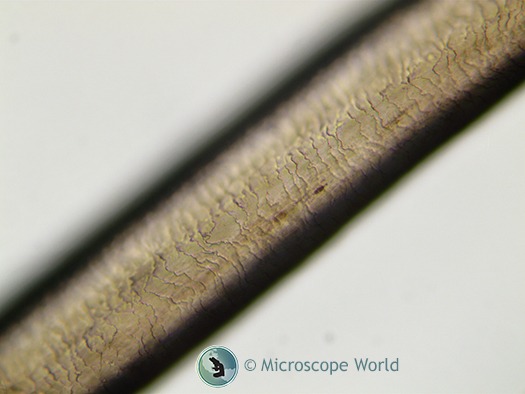
A 70 μm diameter is 0.007 cm, giving a radius of 0.0035 cm. For 100,000 strands averaging 15 cm long, the calculation is 100,000 × 15 × π × (0.0035)2 × 1.312 ≈ 75.7 g, or 2.67 oz.
The density comes from a 2020 Molecules study of hair fibers. Researchers reported a human-fiber density of 1.312 ± 0.043 g/cm³ using 10 hairs from two people. The salon term dense hair usually refers to the number of strands growing in an area of scalp.
How different assumptions change the estimate
The table keeps density at 1.312 g/cm³ and changes only the number, length, or diameter of strands.
| Scenario | Strand count | Mean fiber length | Diameter | Estimated mass |
|---|---|---|---|---|
| Shorter, finer hair | 80,000 | 10 cm (3.9 in) | 50 μm | 20.6 g (0.73 oz) |
| Worked example | 100,000 | 15 cm (5.9 in) | 70 μm | 75.7 g (2.67 oz) |
| Twice the length | 100,000 | 30 cm (11.8 in) | 70 μm | 151.5 g (5.34 oz) |
| Longer, coarser combination | 120,000 | 30 cm (11.8 in) | 90 μm | 300.5 g (10.60 oz) |
Compare the second and third rows. Count and diameter stay the same, and doubling the length doubles the mass. Doubling the diameter, with everything else fixed, multiplies the mass by four, because cross-sectional area grows with the square of diameter.
Real hair has strands at different growth stages, with different lengths, widths, and cross-sectional shapes. In curly hair, the distance along a strand can be considerably greater than the length it appears to hang below the scalp. The model treats every shaft as the same cylinder so the variables stay visible.
Does Wet Hair Weigh More Than Dry Hair?

Yes. Wet hair carries extra water, and some of it leaves as the hair drips or dries.
Water enters the fibers themselves. More clings to the outside or collects between strands, and a thick, dripping braid holds water in those gaps. Hair that feels dry still contains some moisture at ordinary room humidity, because the fibers exchange water with the surrounding air. After a shower, the free water drains or transfers to a towel, so the same strands feel lighter once towel-dried.
Researchers have studied that exchange in untreated, bleached, and heat-shaped hair. The study of moisture sorption by Breakspear and colleagues found behavior that varied with humidity and the state of the hair.
The research, first published in November 2024, described a change in moisture-sorption behavior around 30% relative humidity. That 30% describes the humidity of the air. It doesn't say how much weight a wet hairstyle gains.
What About Braids, Extensions, Haircuts, and the Scale?
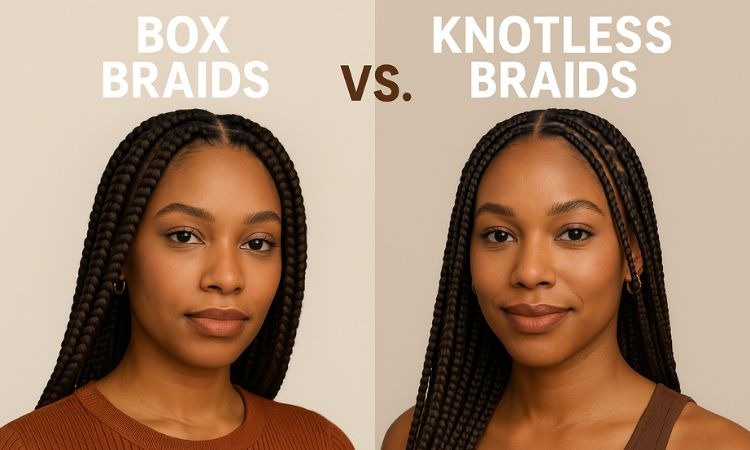
Some hairstyles contain more than the hair growing from your scalp; braids made only from your own strands just rearrange them. Installed extensions add synthetic or human hair, and beads, ties, and other accessories add mass too.
A person in r/loseit described an unexpected reading after having waist-length braids installed:
I’m not sure if this is allowed but I thought it was funny. Also hopefully this hits the word count
I got my hair done yesterday and this morning went to weigh myself and was five pounds heavier! I’m sure this is my hair simply because I didn’t eat very much yesterday + had a good walk after getting my hair done.
I’ve never considered the impact that having my hair done would have on my weight but waist length braids being five entire pounds is shocking! It doesn’t feel that heavy on my head anyway, and I’ve had some heavy braids before. This makes me wonder how much those weighed!It was something I thought about yesterday when I went to get it done but I forgot to weigh myself and didn’t think it would be more than one extra pound
The five-pound change was a next-morning reading of the whole person, and the braids were never weighed on their own. A bathroom scale counts everything attached to or worn by you, and food, fluid, clothing, and weighing conditions shift the number from day to day.
| What is weighed | What the weight includes | What the number tells you |
|---|---|---|
| Natural scalp hair | Your own hair shafts | What the fiber model estimates |
| Braids with extensions | Your hair plus the added material | Total hairstyle weight |
| Collected haircut clippings | The hair that was cut off | A sample you can weigh directly |
| A person on a bathroom scale | Body plus anything attached | Total body weight |
For added hair, the packaging or a separately weighed bundle gives you a reference amount.
Why Hair Can Feel Heavy or Hurt Without Weighing Much
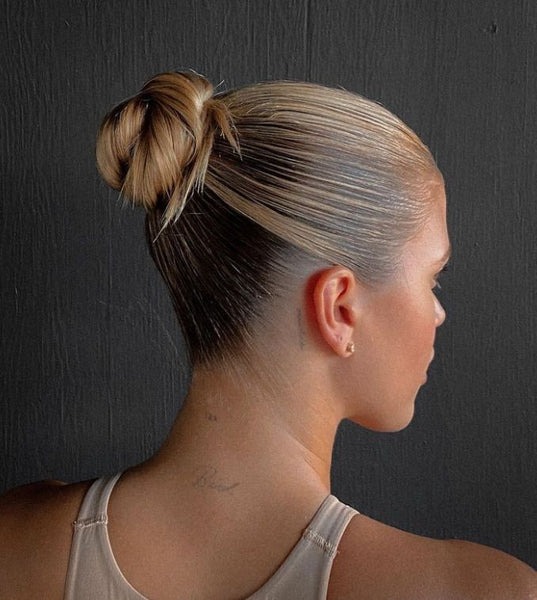
A hairstyle can concentrate pulling force at particular points on the scalp. Total hair mass adds to the load, and the position of ties, pins, buns, and braids decides how that force is distributed.
A person with very long hair described an awkward consequence in r/longhair:
Loose braids is about all I can do now, I was the queen of messy bun, but its hurting my neck and if I do a high ponytail it does pull on my scalp and hurt. Like I would do any kind of bun and not be able to sit in the car without a very leaned forward neck.
I switch between something like a loose Elsa braid (princess braid) and pig tail braids.My hair is to about the middle of my butt and I'm thinking of getting a cut because I cant do any hairstyles, I asked my hair dresser for curls at Halloween, she said they'd fall out, at new year's I asked for an updo, she said impossible lol
A bun that presses against a car seat forces the wearer to change posture. A different arrangement changes the pressure and pulling without removing any strands.
In a 2004 study of ponytail-associated headaches, 50 of 93 women in the sample reported headaches when wearing a ponytail.
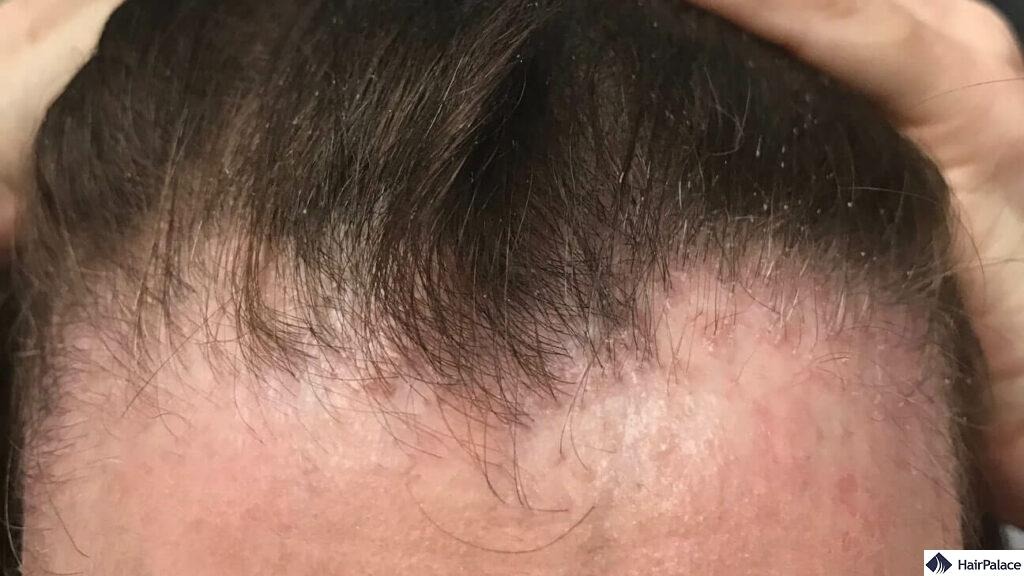
The American Academy of Dermatology's hairstyle guidance explains that repeated pulling can contribute to traction alopecia, a form of hair loss linked to sustained tension.
If a hairstyle pulls or hurts, loosen or remove it. If scalp pain persists, or you get unexplained headaches or hair loss that keep coming back, see a healthcare professional.
How Can You Estimate or Check Your Own Hair's Weight?
The four table rows show the scale of possible results even if you've never measured your own fibers.
To make an estimate:
- Use your own numbers if you have them. Record strand count, mean length along the fibers, and diameter. If you don't know count or diameter, pick the table row closest to your hair.
- Apply the formula. Use the centimeter units and the density given above. If more than one combination of inputs looks plausible, calculate each.
What if you have actual hair to weigh?
Hair collected during a planned haircut can be weighed once dry, on a scale sensitive enough for the sample. If only part of the head was cut, the weight covers only those clippings.
You don't need to cut your hair just to find out what it weighs.