Transverse Abdominis Exercises: A Practical Deep-Core Guide
If you are otherwise healthy, start with a gentle deep-core cue, then move to whole-core exercises you can control while breathing normally. Perfect isolation of the transverse abdominis isn't necessary. If pain, recovery, or a medical condition affects which exercises you can do, follow a plan from a qualified clinician. Otherwise, pick the easiest movement that feels comfortable and build from there.
What your transverse abdominis does
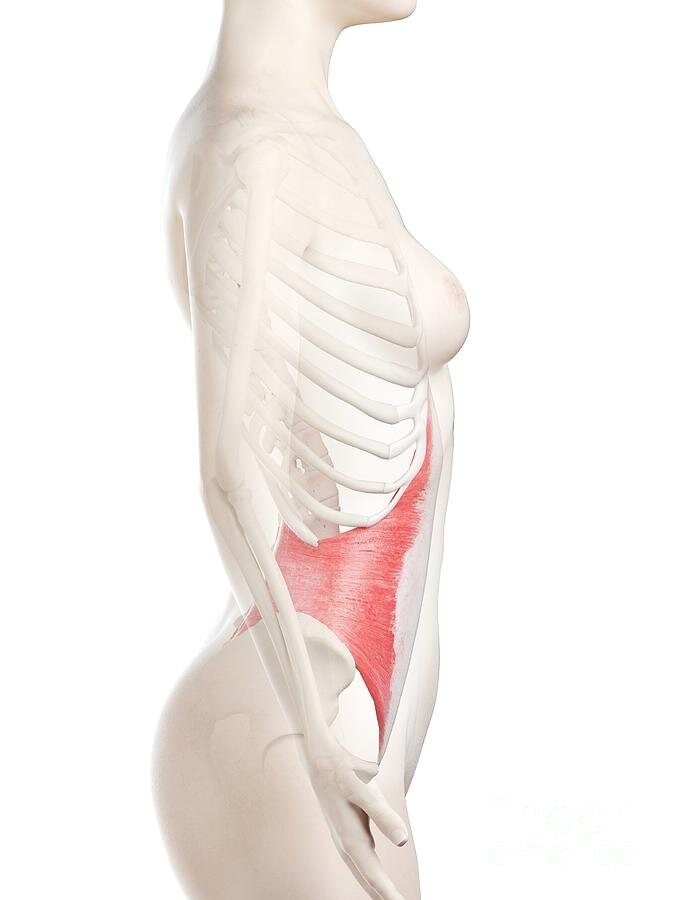
The deepest of the lateral abdominal muscles is the transverse abdominis (TrA); its fibers run mostly across your abdomen, beneath the internal and external obliques. The rectus abdominis, the muscle behind the visible six-pack, sits closer to the surface.
When your trunk needs support, TrA helps tighten the abdominal wall. It works with the diaphragm, multifidus, pelvic floor, and other muscles during breathing and movement.
Any exercise that tests trunk control already uses your deep core. A bird dog or plank asks several muscles to work together. Deep-core bracing, band resistance, and trunk stabilization are covered separately in the resistance-band ab workout guide.
Most healthy, active adults do not need a dedicated TrA isolation workout. UW Medicine's guide to deep-core training explains how ordinary exercise recruits the deep abdominal muscles. Practicing the cue still helps if “engage your core” leaves you puzzled.
Hollowing versus bracing: two ways to engage your abdomen
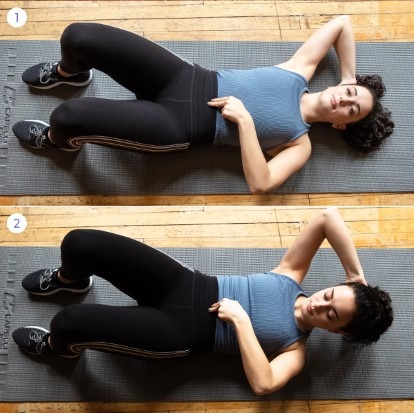
Hollowing and bracing are different tasks. Hollowing, also called the abdominal drawing-in maneuver (ADIM), is a gentle inward movement of the lower abdominal wall. Bracing builds coordinated tension around the trunk to resist movement or manage a load.
| Cue | What you do | Useful situation | Watch for |
|---|---|---|---|
| Gentle drawing-in | Draw your lower abdomen in lightly as you exhale easily | Learning a light contraction while supported | Hard stomach sucking or a held breath |
| Abdominal bracing | Build steady tension around your trunk | Resisting movement or preparing for resistance | Straining harder than needed or holding your breath |
| Moving with a steady trunk | Keep your torso still while an arm or leg moves | Toe taps, dead bugs, and bird dogs | Twisting, arching, or rushing |
A small inward draw makes an unfamiliar cue easier to learn. Bracing fits when the exercise calls for broader trunk tension. A 2024 scoping review of hollowing and bracing found varied results across exercise types and study populations. Neither method came out ahead in every situation.
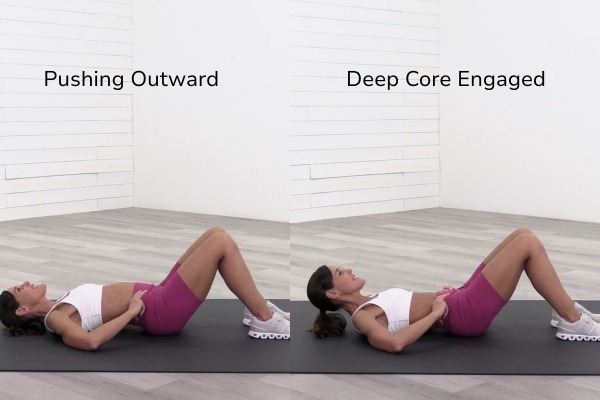
Start with a gentle draw-in while breathing normally
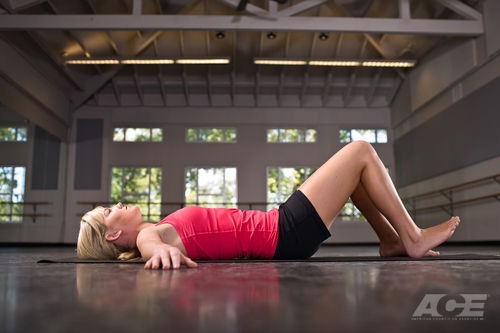
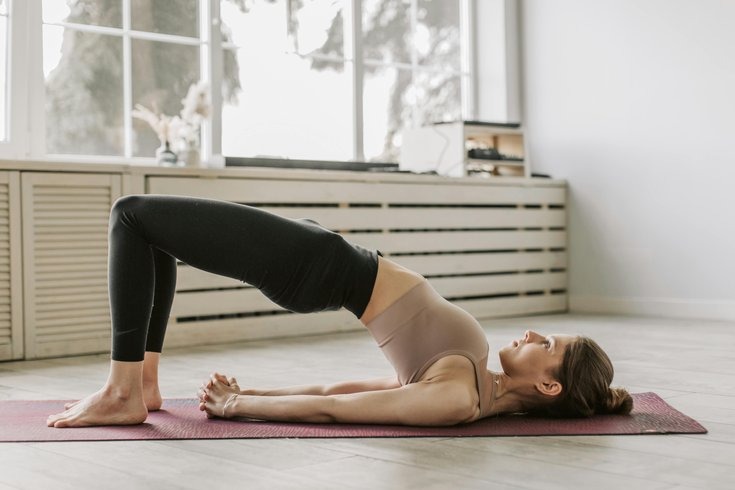
Lie on your back with your knees bent and your feet supported. This position lets you find a light lower-abdominal contraction without the demands of a full exercise.
- Settle in. Rest your head and shoulders. Let your arms relax.
- Exhale softly. Let your lower abdominal wall move in a little. Keep the effort mild and do not pull your belly hard toward your spine.
- Take the next breath. Hold only as much tension as lets you keep breathing comfortably. If your shoulders rise or your face tightens, ease off.
- Release. Relax your abdomen and notice how it feels before you try again.
Light fingertip contact just inside the front of the hip bones can help you find the area. Feeling movement under your fingers does not prove that TrA alone is contracting. If the inward cue confuses you, create a small amount of lower-abdominal tension during an ordinary exhale.
One longtime Pilates participant described finally understanding a cue after switching studios:
So, I’ve been doing Pilates on and off for 5 years (and yoga for 10), but I switched to a new studio this year. For the first time in my life, an instructor actually explained the TVA to me.
Wild, right? But to be fair, my previous studio was quite “relaxed”, so I’ve been basically flying blind for half a decade. Shoutout to my current instructor and bless him for cluing me in!! It explains so much, like why I’ve always had super tensed shoulders and occasional bout of tendinitis. I was clearly working hard, just in all the wrong places.
Now, my classes are just a constant loop of me trying to “zip up” my core while he reminds me to stop wearing my shoulders as earrings. It’s a lot of mental gymnastics!
Four ways to train your deep core through movement
Toe taps, dead bugs, bird dogs, and supported planks all test trunk control. Each uses a different position and different moving parts, so pick the one you can control.
| Exercise | Starting position | Main challenge | Easier variation |
|---|---|---|---|
| Toe tap | On your back, knees bent and raised | Keep your torso still as one foot lowers | Lower the foot less far, or keep one foot supported |
| Dead bug | On your back, knees raised and arms above shoulders | Control the movement of one limb or opposite limbs | Move one limb at a time |
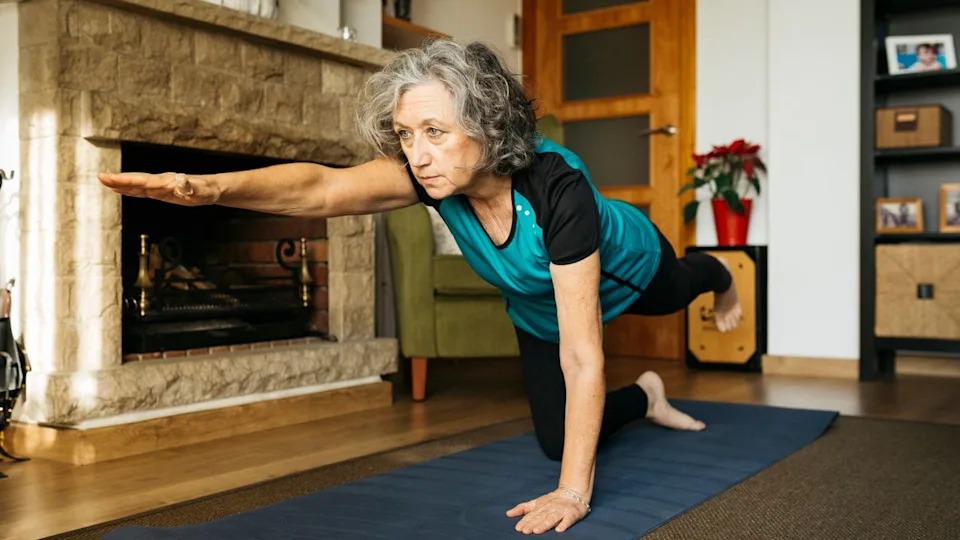
| Bird dog | On hands and knees | Limit rotation as an arm and the opposite leg reach | Reach less far, or move one limb |
| Supported plank | Forearms and knees on the floor | Hold your trunk steady under load | Adjust your support and stop when your form breaks down |
Try toe taps or a dead bug if you are comfortable on your back. Bird dog moves the work to your hands and knees. A supported plank asks you to hold steady.
Toe taps: a small, controlled leg movement
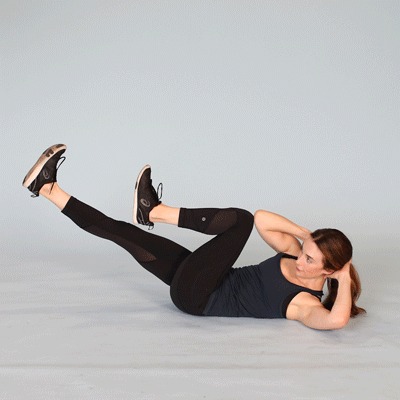
Lie on your back with your arms resting beside you. Bring one bent knee, then the other, above your hips so your shins are roughly parallel to the floor. Slowly lower one foot toward the floor, keep the other leg still, and return. Your toes can touch the floor if you reach it with control.
If your pelvis tips or your lower back shifts sharply, shorten the lowering distance. A one-foot-supported march is an easier alternative to the raised-leg version.
Dead bugs: coordinate an arm and leg
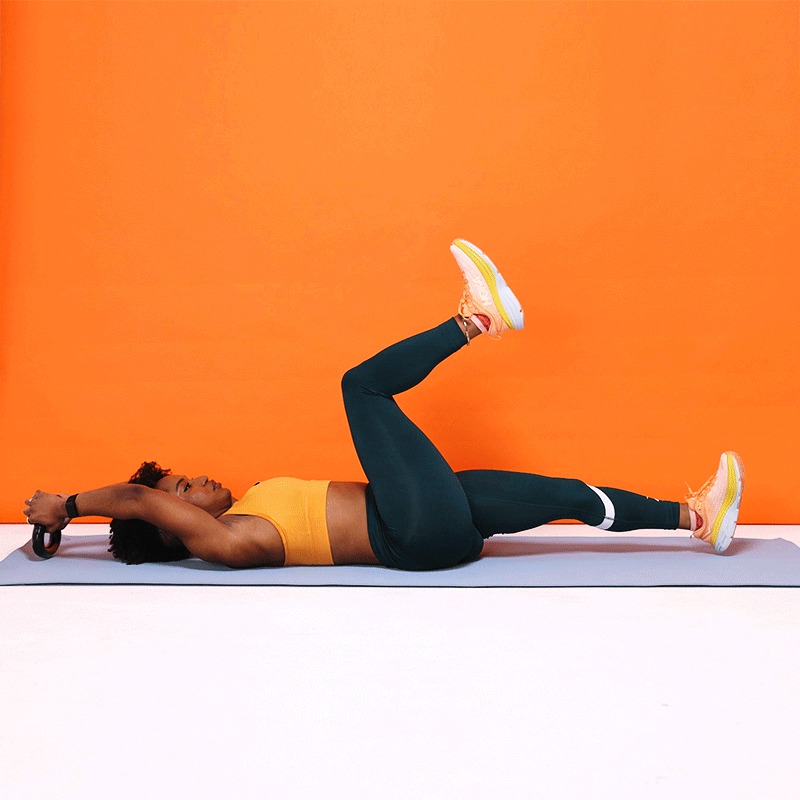
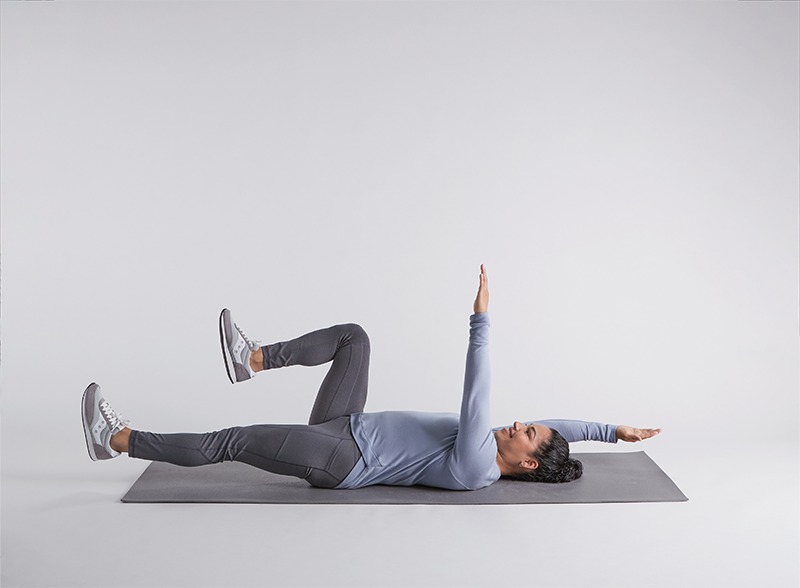
From your back, raise your bent knees over your hips and reach your arms toward the ceiling above your shoulders. Start by slowly moving just one arm or one leg away from the starting position, then bring it back with control.
Once a single-limb reach feels manageable, move one arm and the opposite leg together. Keep the reach short enough that your trunk stays steady. You do not need to force your lower back flat against the floor.
Bird dogs: resist unwanted rotation
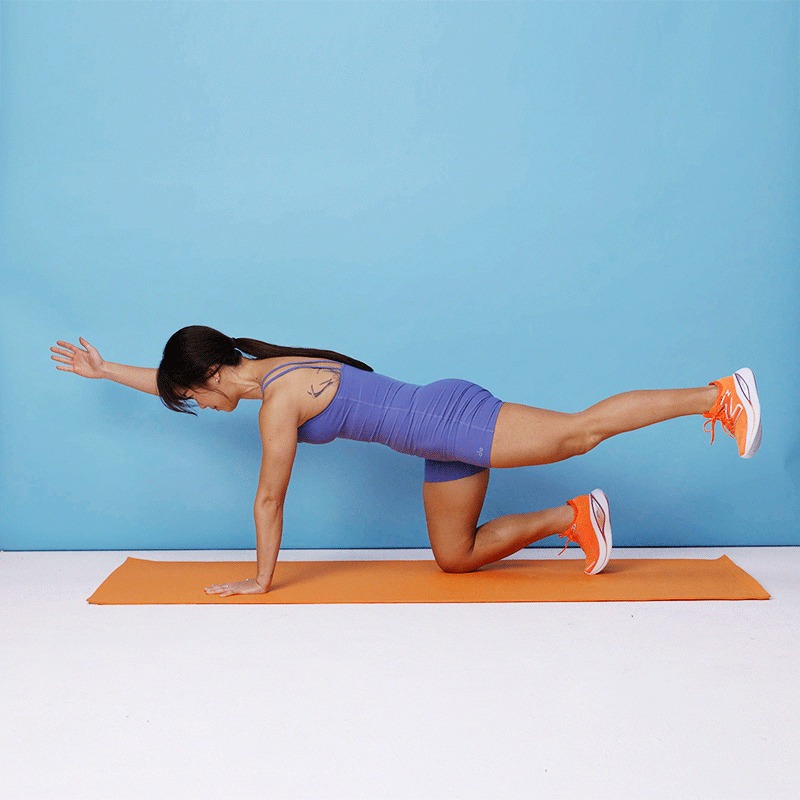
Start on hands and knees, with your hands beneath your shoulders and your knees beneath your hips. Reach one arm forward and the opposite leg backward. Do not roll your torso to one side as you extend, and return with control. If the combined reach is hard, move just an arm or just a leg.
The NASM bird-dog demonstration shows a hands-and-knees setup and opposite-limb extension with a steady torso.
Supported planks: hold position under load
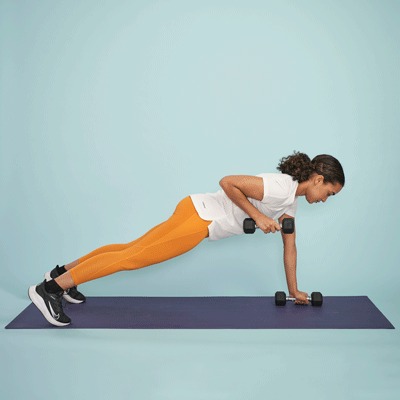
Place your forearms on the floor with your elbows beneath your shoulders. Keep your knees on the floor and hold a straight line from your head to your knees without letting your lower back sag.
A straight-leg plank on your toes is harder. Move to it only when the supported version feels steady and comfortable.
Progress when the movement stays controlled
Increase one demand at a time once the current variation feels smooth. Extend a leg a little farther in the dead bug, move an opposite arm and leg together, or change how you support a plank. If you start rushing or losing control, return to an easier version.
A commenter in r/xxfitness described how dead bugs gave them immediate feedback:
ok so the punch in the stomach cue that everyone mentions is good but the thing that actually made it click for me was dead bugs. like i could not for the life of me figure out what "engage your core" meant during squats until i started doing dead bugs as a warmup every single session
basically you lie on your back, press your lower back into the floor (thats the core engagement part), and then slowly extend opposite arm and leg while keeping your back glued down. the second you feel your back start to arch you know youve lost it. its like a built in feedback loop
once i could feel that during dead bugs it translated so much better to everything else. squats, deadlifts, even just standing overhead press. i think the problem with the "brace like youre about to get punched" thing is that for some people it just turns into holding your breath and tensing everything which isnt really the same thing
also bird dogs are great for this too, similar concept but on all fours. between those two exercises something just clicked after like a week of doing them consistently before every workout
For this lifter, the dead bug turned a vague lifting cue into something they could feel. You do not need to feel a specific muscle to get the same feedback. Your reach, support, and trunk position show you how the movement is going.
If your hip flexors, back, or shoulders seem to take over
Struggling to feel a deep abdominal contraction does not mean TrA is weak or inactive. In a core exercise, your hip flexors, back, shoulders, and abdominal muscles all contribute to what you feel.
One r/bodyweightfitness poster described doing demanding core work and still wondering whether their deeper abdominal muscles were working:
I've had back pain and anterior pelvic tilt for most of my life due to excessive sitting playing video games and just general life. The past year or so I have been trying to reverse the effects of all this sitting on my body by doing barbell rdls for posterior chain strength and stretching my hip flexors. I have also been doing core work like hollow body holds and hanging knee raises.
I have seen pretty good results and have had a very noticeable decrease in back pain - it used to hurt if I stood or walked slowly for too long - to where it's not something I notice at all really anymore.
Although my apt has improved and my posture in general is not as curved as it used to be, I recently began to think that although I feel like my core is relatively strong, I feel like my superficial ab muscles are overcompensating for my weak transverse abdominis and are not letting me properly develop this muscle.
I have watched some videos and read about it but I can't seem to really activate my ta without my rectus abdominis taking over and not allowing me to properly work the deeper core muscles.
What are some of the most basic exercises I can start with and cues to help me activate my ta?
Use what you can observe in the exercise to guide a practical adjustment.
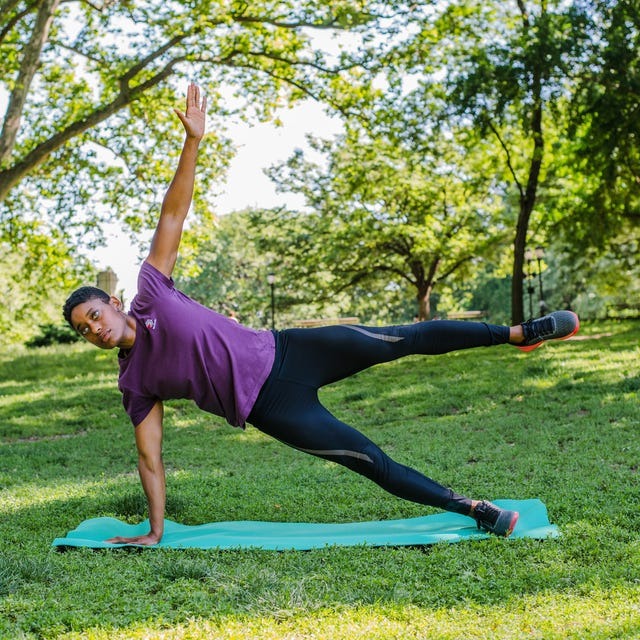
| What you notice | What is happening | One adjustment |
|---|---|---|
| You stop breathing or tense your face | The effort is too high | Reduce the intensity of the contraction |
| Your back arches sharply during a leg reach | The reach is longer than you can control | Shorten the leg movement |
| Hip flexors dominate what you feel | The leg position is too hard | Keep one foot supported |
| Your neck or shoulders tighten | Extra tension from your upper body has joined in | Change your arm support and relax your shoulders |
| Your trunk rotates during bird dog | Reaching with opposite limbs is hard to control | Move only one limb |
If the change steadies the movement, keep that version. Pain or concerning symptoms mean you stop, as the last section explains.
What research shows about activation and results
Research on hollowing and bracing usually measures what muscles do during one task.
| Study | Sample or material | What was examined | Result |
|---|---|---|---|
| 2024 scoping review | 22 randomized trials, nine comparing both techniques | Hollowing and bracing across different exercises and populations | Neither technique came out ahead in every case |
| 2026 crossover study | 18 healthy adults, nine women and nine men | Ultrasound TrA thickness during a static task; surface EMG (electrical activity measured through the skin) during a dynamic toe tap | Hollowing gave greater static TrA thickness; surface EMG showed no significant difference between techniques in the dynamic task |
| 2018 feedback trial | 20 healthy participants over two weeks | Relative abdominal activation using ultrasound feedback during hollowing practice | Feedback improved the relative activation measure; resting thickness did not change significantly |
| 2019 bridging comparison | 20 healthy participants | Ultrasound-derived TrA thickness and activation ratios across exercise positions and cues | Results depended on position and technique, including a bridge condition |
The 2026 study's dynamic surface EMG measured rectus abdominis and the accessible obliques. It did not record TrA electrical activity directly. The randomized crossover study in healthy adults describes this comparison.
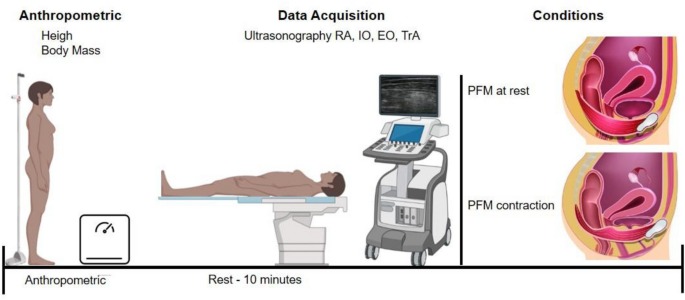
Feeling tension during a drill is subjective. Ultrasound tracks thickness changes under set conditions, and surface EMG records electrical activity from the muscles it can reach. A training study that measures lasting strength, or a clinical study that measures pain, asks a further question.
Measurements from a single session cannot show long-term back-pain relief, waist reduction, injury prevention, or better strength gains from one cue over another. The 2021 clinical practice guideline for low back pain discusses trunk-muscle activation as one option within patient-specific clinical exercise care.
When a general core routine is unsuitable
If an exercise causes pain or concerning symptoms, stop that movement. Persistent back pain, recent surgery, pregnancy or postpartum recovery, diagnosed diastasis recti, and pelvic-floor concerns call for exercise selection with a qualified clinician.