
Do Almonds Help You Sleep? What the Human Studies Show
Almonds can be a perfectly ordinary snack; enjoying and tolerating them matters more than a promise about sleep. A 20-week trial found better self-reported sleep, but a second randomized trial found no difference, and nobody has shown that a handful at bedtime works right away. If almonds bother you, skip them.
What the 2026 almond study found about sleep
In a July 2026 randomized trial, people eating almonds for 20 weeks reported improvements on several sleep questionnaires. Home-based polysomnography (PSG), which records physiological signals during sleep, showed no statistically significant difference on most objective measures.
Researchers led by Sharvari Desai studied adults aged 21 to 55 in urban India who described their sleep as poor. People with chronic insomnia or other major sleep disorders were excluded. One group received raw almonds each day for 20 weeks; another received calorie-matched snacks. Participants knew what they were eating, but outcome assessors did not.
The 2026 study in Frontiers in Nutrition reported these average results for participants who completed the intervention. The ± figures are standard errors (SE), and PSQI is a sleep-quality questionnaire.
| Sleep measure | Almond group | Control group | p-value |
|---|---|---|---|
| Overall sleep quality, PSQI score (lower is better) | 3.94 ± 0.24 | 4.79 ± 0.32 | .013 |
| Self-reported sleep efficiency | 94.45 ± 0.72% | 91.85 ± 0.42% | .012 |
| Self-reported time to fall asleep | 18.46 ± 2.25 min | 26.29 ± 2.27 min | .016 |
| PSG-measured sleep efficiency | 85.10 ± 0.74% | 84.87 ± 0.74% | .826 |
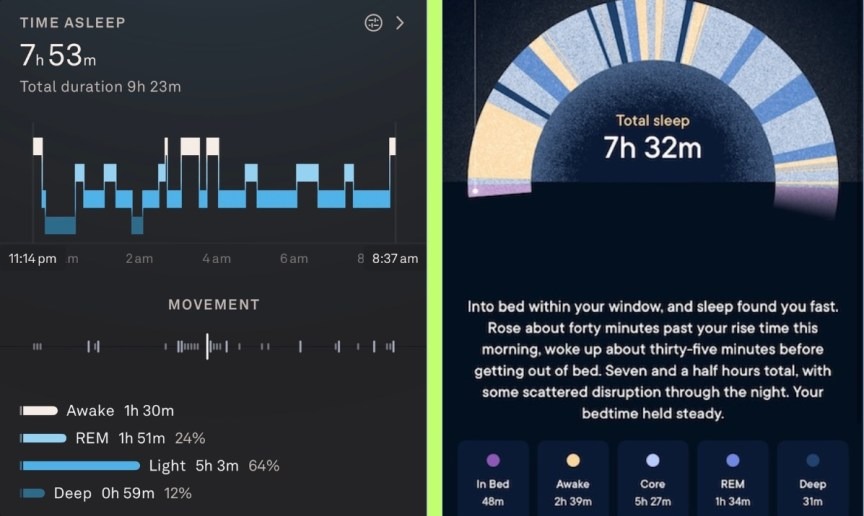
The first three rows come from participants' own reports and favor almonds. The fourth comes from PSG and shows no significant difference, and most other PSG outcomes were nonsignificant too.
The paper contains one inconsistency: its detailed flow describes 209 people randomized and 175 in the final analysis, while its abstract calls the 175 randomized.
The Almond Board of California funded the trial; it was open-label, and some participants dropped out before the final analysis.
What other human studies add
In a 2023 trial, Brown and colleagues randomized 136 nonobese adults who habitually ate snacks to almonds or calorie-matched biscuits for one year. Sleep was a secondary outcome; the prespecified primary outcomes were body weight and subjective appetite.
Sleep duration, latency, habitual sleep score, and disturbance score did not differ significantly between groups under either analysis method, as reported in the 2023 trial in The American Journal of Clinical Nutrition.
In 2017, researchers gave 10 sweet almonds a day for 14 days to dormitory students at Tehran University of Medical Sciences; the study was published in 2019. They provided almonds to 446 students and reported findings for 442.
On an Insomnia Severity Index questionnaire, the number classified as having insomnia fell from 343 (77.6%) to 306 (69.2%).
Every student received almonds and there was no randomized concurrent control group, so the change can't be credited to the almonds.
What magnesium and melatonin can explain
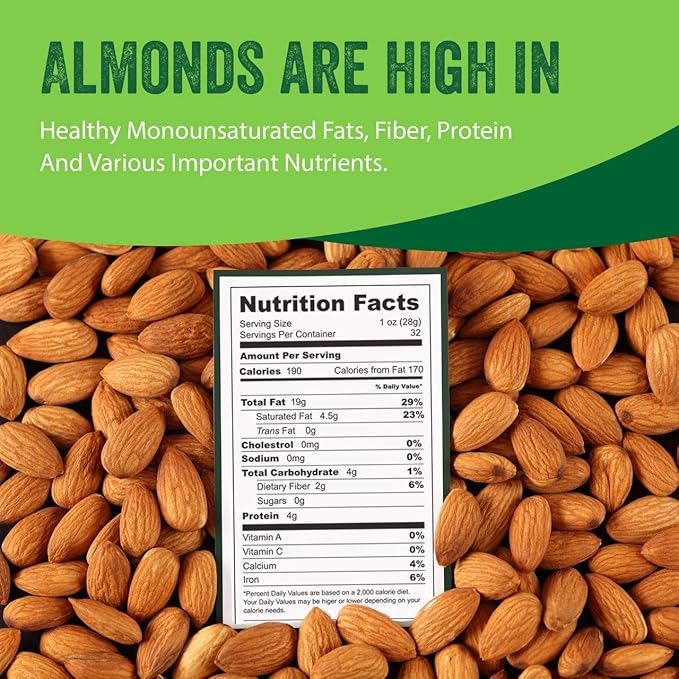
Almonds provide magnesium, and researchers have detected melatonin in almond samples. That makes a sleep connection plausible, but neither finding gives a dose of almonds that reliably improves sleep.
According to the NIH Office of Dietary Supplements, one ounce (about 28.3 g) of dry-roasted almonds contains 80 mg of magnesium, equivalent to 19% of the US Daily Value.
Magnesium supplements have been studied for sleep too. A 2026 systematic review by Lopresti and colleagues covered 12 randomized trials in the main sleep analysis and found inconsistent results backed by low-to-very-low-certainty evidence.
Reported melatonin concentrations in almonds depend on the sample and analytical method. A 2019 chemical analysis by Paroni and colleagues found 643 to 2,110 picograms per gram of sampled almonds.
The 2026 trial also measured melatonin in participants' blood. The adjusted end-of-study comparison was borderline at p=.050, and the comparison of changes between groups was not statistically significant at p=.087.
How many almonds were studied, and when?
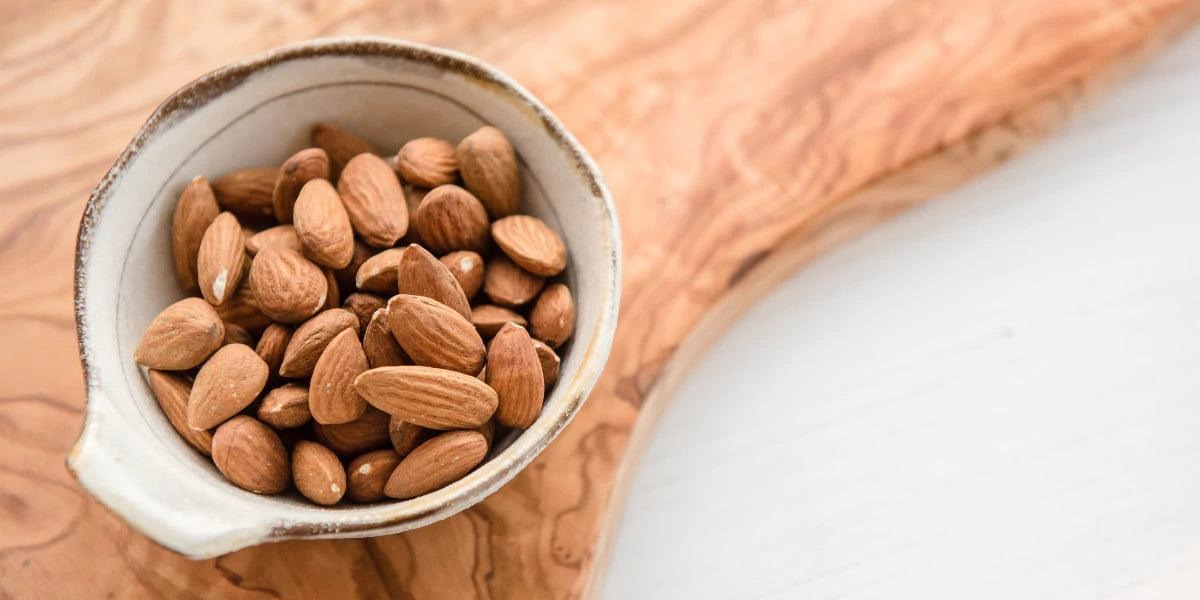
The 2026 experiment used 60 g of raw almonds daily, approximately 50 almonds, split between midmorning and evening snacks for 20 weeks. It did not test a single handful eaten just before going to bed.
| Reference | Almond amount | Schedule | What was measured |
|---|---|---|---|
| 2026 randomized trial | 60 g/day, raw, about 50 almonds | Two portions daily for 20 weeks | Subjective and objective sleep outcomes |
| 2023 randomized trial | 10% of energy needs or 42.5 g/day, whichever was greater | Daily for one year | Sleep outcomes as secondary measures |
| 2019 student experiment | 10 sweet almonds/day | 14 days | Before-and-after insomnia questionnaire classifications |
| NIH nutrition reference | 1 oz (about 28.3 g), dry-roasted | Food-composition serving | Magnesium content, no sleep outcome |
Sixty grams is roughly 2.1 ounces, a little more than twice the one-ounce nutrition reference. Nut size changes the count, and raw and dry-roasted almonds differ slightly.
The 2026 control group's calorie-matched snacks included khakra, chivda, cookies, and crackers.
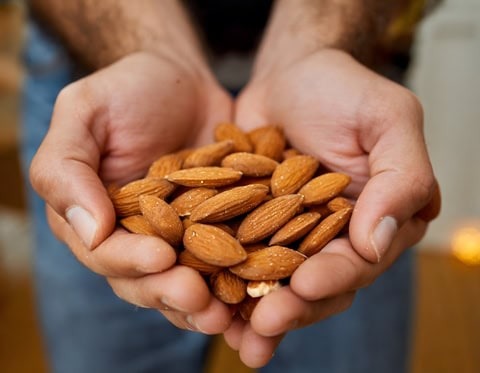
Raw almonds are perfect for an early evening snack. They contain melatonin as well as magnesium, Around 20-40g is more than enough. The fat isn’t an issue. I used to eat 30g at lunch and it made me sleepy so I switched to the evening.
Would almond butter work the same way?The 2026 trial used whole raw almonds only, so it says nothing about almond butter.
When an evening almond snack fits

Compare almond portions, fat content, and other nut nutrients in the nut nutrition table.
| Your situation | Food decision |
|---|---|
| Hungry and comfortable eating almonds | Consider a modest snack |
| Already full or bothered by late eating | Skip the extra snack |
| Known almond or relevant tree-nut allergy | Avoid almonds |
I avoid eating in the 3 hours before bedtime otherwise I wake up within a few hours and have terrible sleep but if I have to have a snack it’s protein, no carbs, no sugar. String cheese, almonds, walnuts, turkey. All of those can help promote better sleep except maybe not string cheese. Bananas give me weird dreams 🍌✨🛸
When sleep is still a problem
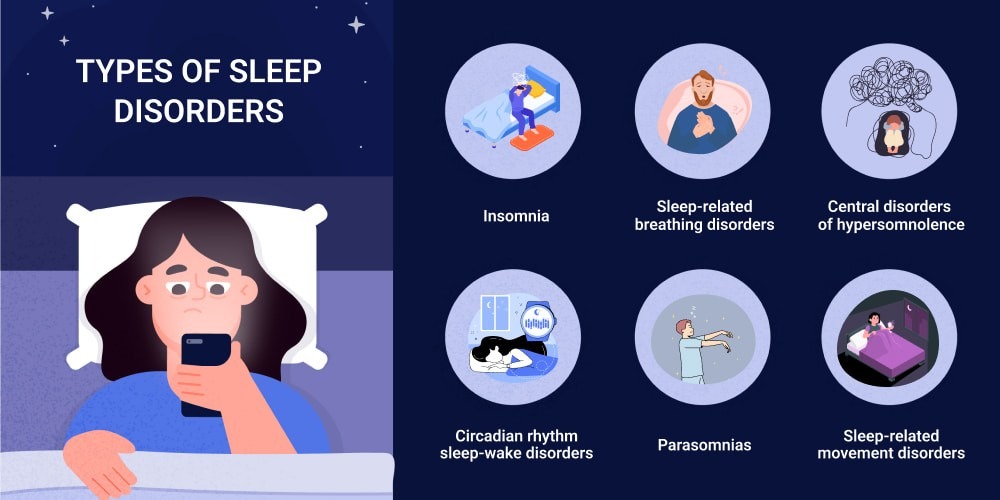
Trouble falling asleep, repeated waking, or sleep problems that interfere with your day need more than a change in snacks. The NIH NCCIH overview of sleep disorders covers the broader picture; see a doctor if the problem persists.