
What Is a Double Crown? Two Hair Whorls, Genetics, and Haircut Choices
A double crown is a natural pattern in which two hair whorls shape the way hair grows at the top of the head. If you've always had both, cut and style your hair with their directions in mind. If your coverage gradually changes, or a bald patch or clumps of shedding appear suddenly, see a dermatologist. For a double crown you've had for years, two things drive the decisions: where each whorl sends the hair, and how the crown behaves at different lengths.
What exactly is a double crown?
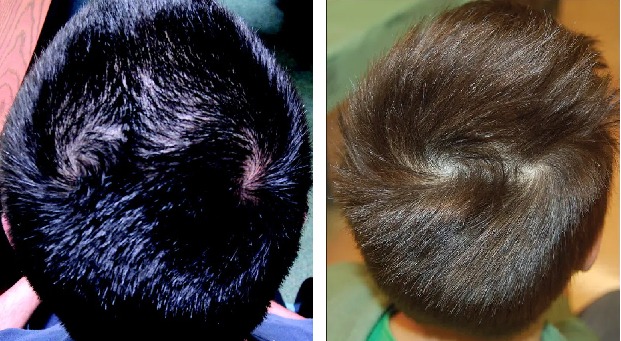
With a double crown, the hair forms two distinct whorls near the vertex, at the upper back of the head. Around each whorl, strands change direction around a center point. Hair between the two centers can separate, lift or leave a strip of scalp showing. The NIH/NHGRI Elements of Morphology lists this two-whorl arrangement as a variation in scalp hair pattern.
How can you tell if you have two hair whorls?
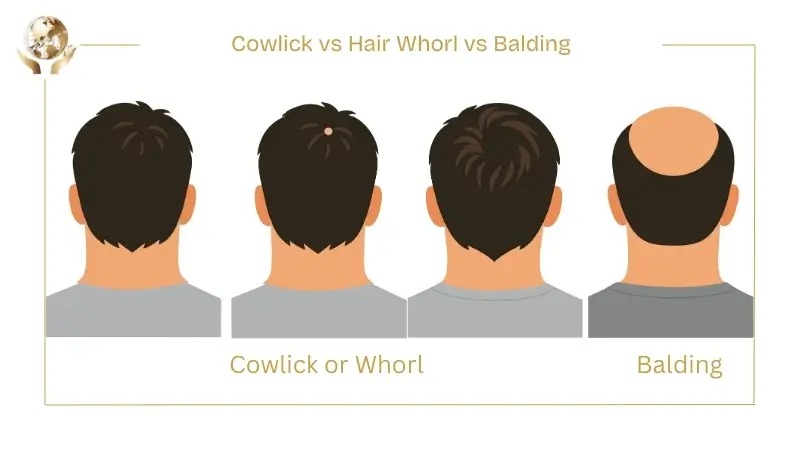
Look for two separate points near the top back of your head where the surrounding hair changes direction. A double crown can leave a curved part, a raised section between the swirls, or two spots where scalp shows through. A visible line can also come from how your hair has been parted, especially when it's wet or brushed into place.
| What you notice | What to look at | What it means |
|---|---|---|
| Two swirls near the vertex | Strands change direction around two centers | You have a double crown |
| One swirl and a long parting line | A single center with strands falling apart along a line | One whorl and a part |
| Hair lifting near the forehead | Growth direction changes at the front hairline | A frontal cowlick |
A quick crown check
- Start with dry hair. Let it settle without combing in a new part.
- Get an overhead view. Use a mirror, a top-down photo or someone you trust.
- Follow the strands. Gently separate the hair around each swirl and see which way it grows.
- Count the centers. Look for two persistent points where the direction changes, then let the hair fall back into place.
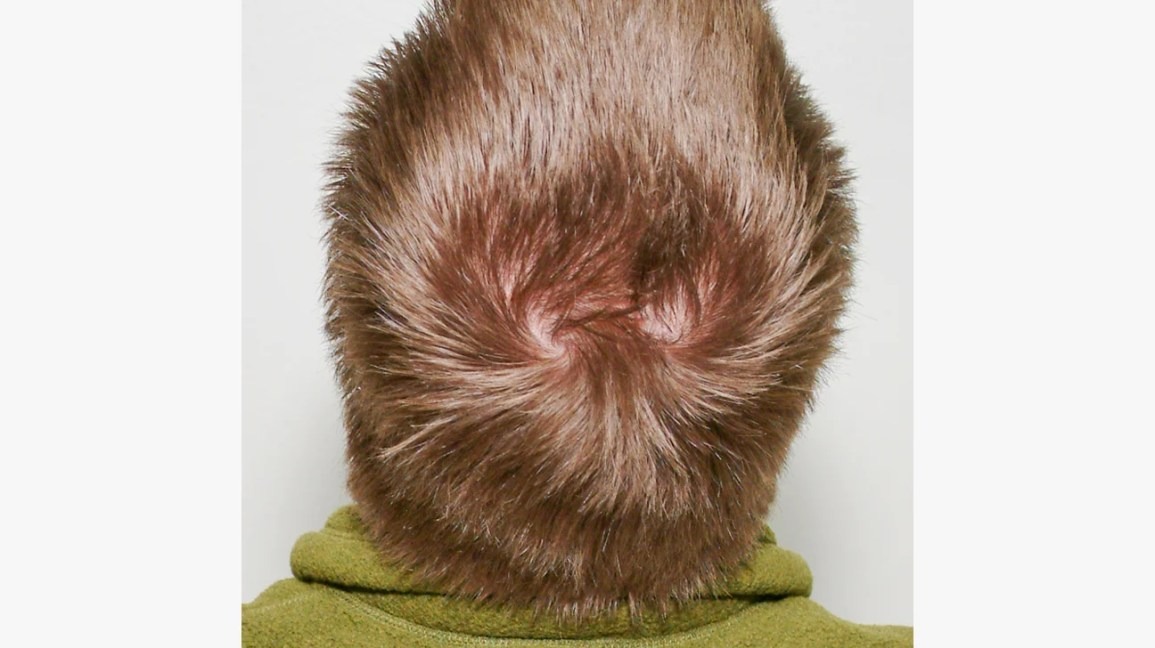
Count whorls by how the strands are arranged around each center, not by how wide the part looks.
Are double crowns uncommon, and are they genetic?
Double crowns are uncommon. Researchers have studied the genetics of whorl rotation, but nothing points to a simple dominant or recessive rule for having two crown whorls.
The NIH/NHGRI terminology reference puts the occurrence at about 5%. A 2005 study in the Korean Journal of Dermatology found double whorls in 6.9% of 655 participants. Among them, two whorls turning in the same direction were more common than whorls turning in opposite directions. The figures come from different sources, so there's no firm US number.
Number and direction are different traits
One person has a clockwise whorl, another a counterclockwise one; someone with two centers can have matching or opposing rotations.
In 2023, Luo and colleagues studied genetic associations with hair-whorl rotation direction. A small twin study by Willems and colleagues, published in 2024, suggested that genes play a part in whorl development, with possible environmental influences too. Whorls and curl patterns are separate traits. For the genetics of curl, read the hair-curl genetics guide.
A 2013 study of 510 children found an additional frontal whorl in 7.8%. That whorl sits at the front hairline, not at the vertex.
Your crown pattern tells you nothing about your intelligence, personality, handedness or neurological health.
Double crown or thinning hair: what changes the answer?
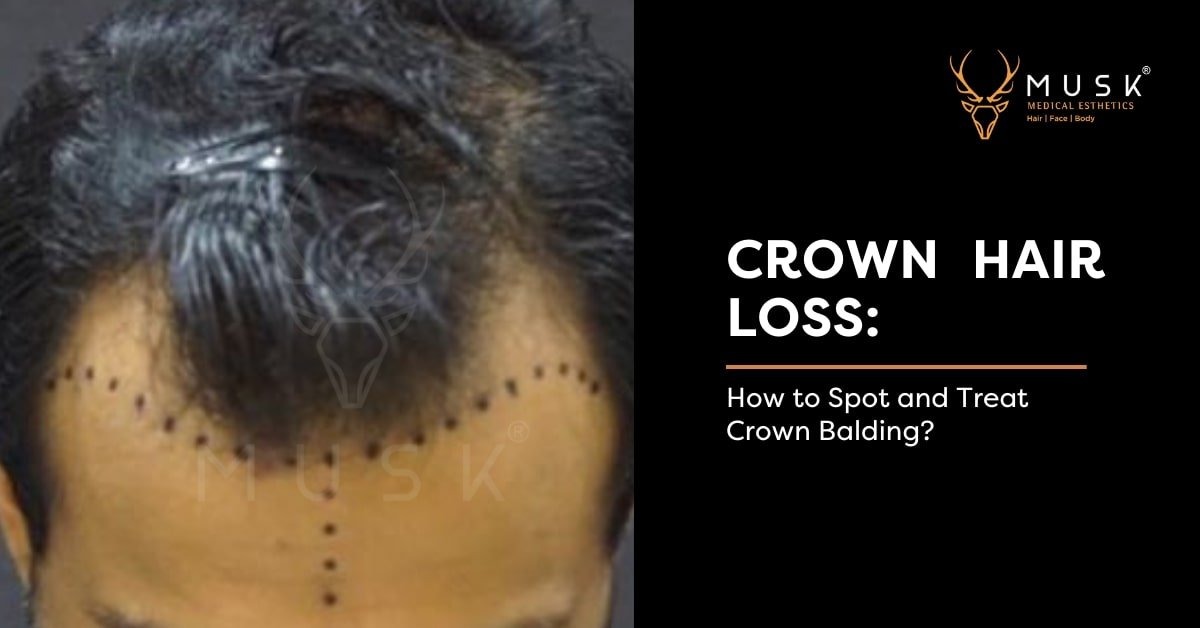
Two hair whorls can expose the scalp where strands point away from each other. Focus on whether your crown has always looked this way or whether the hair coverage is changing, particularly suddenly or progressively.
You can have two natural whorls for years and still start thinning later. Lighting, hair oil, washing and the angle of a photo all change how visible your crown looks.
| Observation | What it means |
|---|---|
| Two familiar swirls that have looked the same for years | A longstanding growth pattern |
| More scalp visible only with wet, oily or deliberately parted hair | Hair condition changes how the part looks |
| A widening part, gradual thinning, an expanding area of exposed scalp or a receding hairline | Can signal progressive hair loss |
| A new bald patch or sudden shedding in clumps | Can signal sudden hair loss |
The American Academy of Dermatology lists progressive changes and sudden bald patches or shedding as possible signs of hair loss. Book a dermatologist for either one.
Make photographs comparable
Compare photos taken from about the same angle, in similar light, with clean, dry hair if you're unsure whether your crown part has widened over time. Look for a repeated difference in coverage or part width, and describe it at the appointment.
Which haircut lengths work with a double crown?
Your cut has to work with both whorls, your hair texture and the look you want. Short, medium and long crowns each have upsides, and each can go wrong in its own way.
| Approach | Upside | Downside | Worth raising if |
|---|---|---|---|
| Very short or textured | Less bulk and an intentional textured look | The swirls show more clearly, and short sections may spring up | You like a close or textured finish and accept visible crown movement |
| Intermediate crown length | Some shape and movement without a long grow-out | Opposing sections can meet in a raised ridge or tuft | Your crown already lifts or splits stubbornly at this length |
| Longer, weighted crown | Length helps some strands fall across a part | Fine hair can flatten, and longer strands can still separate | You want more coverage, and short layers have made your crown stand up |
Start with your last haircut. If a short trim made the crown stand upright, ask for more weight there before repeating it. If you like visible swirls as part of a textured style, a shorter cut may suit you.
Why an awkward middle length happens
Hair grows toward the space between two whorls from different directions. At a certain length, the strands meet there and rise into a ridge or split along the boundary. The cut may lie flat when damp, then change shape as it dries.
Cutting the raised section even shorter removes the length that was helping it settle. That's why a crown that behaved when grown out can turn difficult after a small trim.
Hair texture changes the trade-off
Fine hair can show more scalp at a part, and added length can reduce volume elsewhere. Curly hair adds its own movement to the crown, which changes how two opposing growth directions look in the finished shape.
In a NewBeauty interview with hairstylists, the advice includes keeping useful crown length for some patterns and considering fineness when layering.
What should you tell your barber or hairstylist?
A stylist needs to see how your hair leaves both whorl centers before deciding how much crown length to take off. Judge the result by the shape the hair takes once it dries.
What to say: “I have two whorls at the crown. When this part gets cut too short, it stands up or opens into a part. Could you check where both sides naturally grow before cutting, and can we agree on how the crown should look when dry?”
Bring the details that change the cut
- A previous-cut photo. Show how your crown looked after a haircut that left an unwanted ridge or tuft.
- Your priorities. Say whether you care most about scalp coverage, a deliberate textured finish or less daily styling.
- How your hair behaves. Tell your stylist whether the crown settles on its own or needs drying and shaping every morning.
How do you style a double crown day to day?
Hair from two crown centers pulls in different directions, and styling it damp lets you steer where it falls.
- Start with damp hair. See where each whorl sends the surrounding strands.
- Handle each side separately. Use your fingers or a brush to guide the sections into a part or shape that sits well.
- Set the direction. If you use a blow-dryer, follow the way you want the hair to fall, on a heat setting that's comfortable.
- Check it dry. See whether the sections meet smoothly, form a deliberate part or lift between the centers.
- Change the finish. If the sections keep separating, try a different part or a deliberately textured shape.
A small amount of styling product can add hold or texture, depending on the product and your hair type. Blow-drying shapes the strands temporarily, and your follicles keep their usual growth direction.